


Field Durability of HQ Trays: UV Stability, Impact Resistance
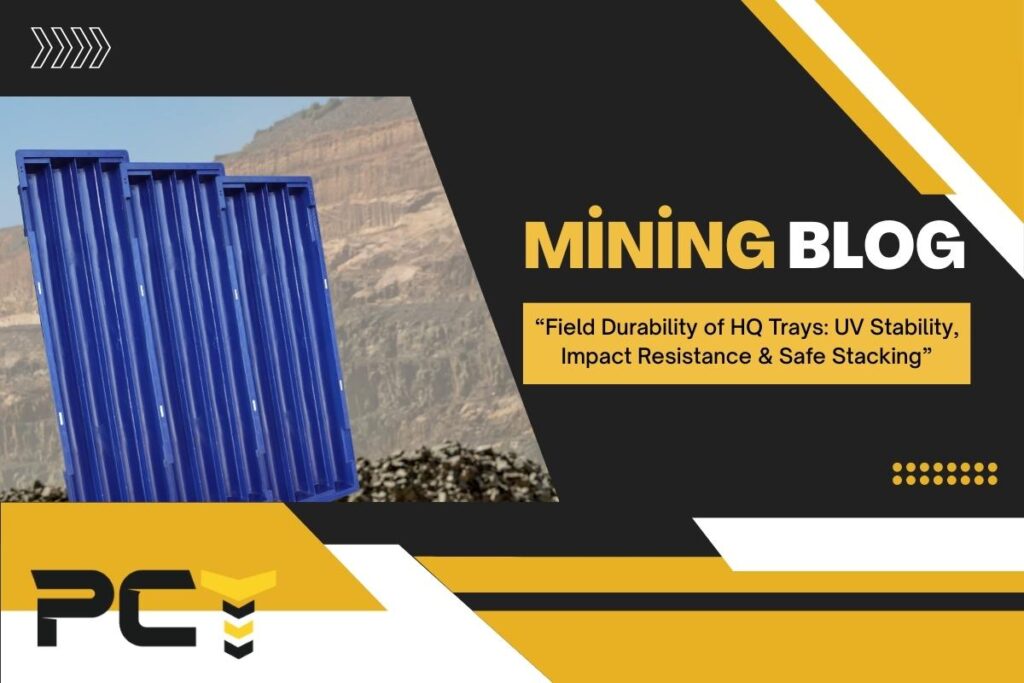
When selecting the right HQ tray for drilling operations, durability is more than a convenience—it is a safety and cost-saving necessity. Mining sites expose trays to extreme UV radiation, high and low temperatures, constant handling, and heavy stacking. A well-designed plastic HQ tray is not only resistant to environmental and mechanical stress but also ensures secure storage of core samples without data loss.
In this guide, we will examine the field durability of HQ trays, focusing on UV stability, impact resistance, safe stacking, cleaning, and lifecycle cost efficiency. Whether you are a geologist, HSE officer, or operations manager, this technical overview will help you make informed purchasing and usage decisions.
Material Behaviour of Plastic HQ Trays Under Field Conditions
Plastic HQ trays, especially those made from recycled plastic core trays, are engineered to withstand multiple external stressors:
-
UV Resistance: High-quality plastic blends are UV-stabilised, preventing brittleness and colour fading when trays are exposed to sunlight in open-core sheds.
-
Temperature Fluctuations: Mining sites may vary between scorching heat and freezing nights. HQ trays retain flexibility without cracking in low temperatures and resist softening under high heat.
-
Chemical Splash Resistance: Oils, drilling fluids, and chemical agents often come into contact with trays. Resistant plastics prevent surface degradation, protecting stored cores.
This durability ensures that a tray used in Australia’s arid mines or Scandinavia’s icy quarries can perform consistently.
Real-World Impact Resistance: Forklifts, Loading & Transport
Mining logistics subjects trays to more than static weight. They are:
-
Dropped during manual loading/unloading
-
Strained under stacked pallets during long transport
-
Struck by forklifts and warehouse machinery
Impact-resistant HQ tray designs prevent cracking or bending, ensuring cores remain intact. For example, the 107×34×8 cm HQ-Size-4 tray is designed to absorb shocks without deforming, protecting valuable geological samples.
Durability here does not only mean survival—it means data integrity, as broken trays can result in sample misalignment, core loss, or mislabelling during analysis.
HQ-Size-4 (49–64 mm, 4×1 m) Technical Durability Signal
The HQ-Size-4 tray, specifically designed for 49–64 mm core diameters and accommodating 4×1 m channels, provides an optimal balance of size, weight, and resilience.
-
The 4×1 m channel layout supports efficient logging while minimising unnecessary handling.
-
The 107×34×8 cm tray dimensions are robust enough for stacking yet lightweight enough for safe manual lifting.
-
Engineers can plan palletisation and racking layouts knowing that each tray is structurally reinforced for repeat use.
This technical specification ensures compatibility with wireline HQ, HQ3, and DCDMA standards, making it suitable for both field and laboratory operations.
Safe Stacking: Best Practices for Core Shed & Pallet Storage
Stacking is unavoidable in both field and warehouse storage. Safe stacking practices reduce risk of accidents and prolong tray life.
-
Stackable Trays: HQ trays feature non-slip surfaces and reinforced edges that lock into each other, preventing sliding.
-
Maximum Stacking Height: For safety, limit stacks to manufacturer guidelines (often 10–12 trays high on stable ground).
-
Pallet Dimensions: With standard pallets measuring 103×108×230 cm, HQ trays can be efficiently palletised for global shipping.
-
Racking & Core Shed Layout: Maintain safe aisle spacing, ensure forklift clearance, and avoid overloading racks.
This combination of tray design and operational discipline ensures both worker safety and sample protection.
Cleaning & Hygiene in Harsh Environments
Durability also extends to maintenance ease:
-
Plastic HQ trays can be quickly washed with water or mild detergents after exposure to mud, oil, or drilling fluids.
-
Unlike wooden trays, they do not absorb moisture or contaminants, eliminating mould and bacterial risks.
-
Smooth interior channels allow fast cleaning without damaging the sample slots.
This not only improves efficiency but also supports compliance with HSE hygiene requirements in field camps.
Lifecycle Cost & Breakage Reduction
The true measure of field durability is the total cost of ownership (TCO):
-
Lower Breakage Rate: Impact-resistant trays have fewer replacements, reducing purchase frequency.
-
Reusability: Recycled plastic trays extend lifecycle without performance trade-offs.
-
Logistics Efficiency: Standardised dimensions simplify storage and palletisation, cutting down transport costs.
A well-selected HQ tray offers years of reliable service, making it more cost-efficient compared to cheaper, fragile alternatives.
Mining operations rely on accurate, secure, and long-lasting sample storage. The HQ tray has proven itself through UV stability, impact resistance, safe stacking, easy cleaning, and lifecycle efficiency. Choosing the right HQ tray—particularly the HQ-Size-4, 49–64 mm, 4×1 m model—ensures not only durability but also higher operational safety and cost-effectiveness.
By integrating durable HQ trays into your drilling logistics, you protect both your workforce and your geological data.