


Gold Mining, Global Practices: How Plastic Core Trays Adapt to Every Exploration Environment
The Global Landscape of Gold Exploration
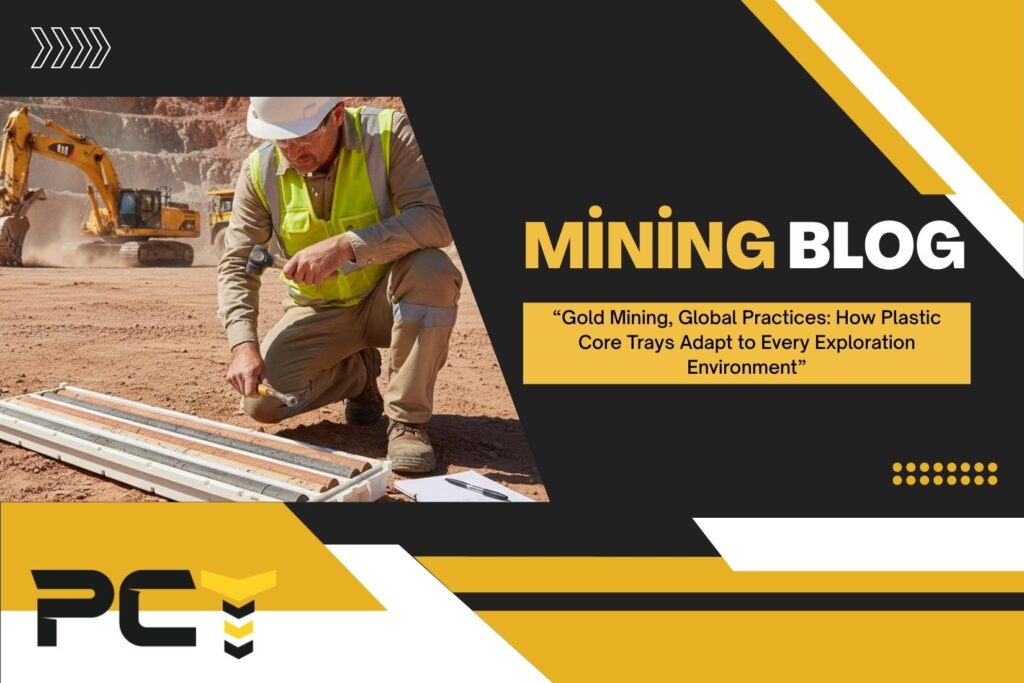
Gold mining is a truly global industry, with exploration projects active on every inhabited continent. Major gold-producing countries span a range of climates – from Canada’s frigid north to Indonesia’s equatorial rainforests, and from Australia’s arid deserts to South America’s high Andes. Exploration teams work in extreme climates and rugged terrains to uncover new gold deposits. No matter the location, certain gold mining equipment remains fundamental. Core drilling rigs and core sampling tools like geological core boxes (core trays) are critical for collecting and preserving rock samples from deep beneath the surface.
In recent years, plastic core trays have emerged as the preferred solution for storing these invaluable core samples across the globe. This shift is driven by the need for equipment that can withstand diverse conditions while keeping geological samples safe and organized. Gold exploration often takes place in remote areas with challenging logistics and weather, making durable and adaptable tools a necessity. The following sections explore how plastic core trays vary by environment in leading gold regions, how tray sizing differs by region, and why field-proven plastic trays offer significant benefits. We’ll also examine how these trays contribute to sustainable practices (an increasing focus of mining companies worldwide) and how they simplify global exploration logistics.
How Core Trays Vary by Environment
Every exploration environment poses unique challenges, and core tray designs have evolved to meet regional needs. Historically, the material and style of core boxes often depended on local resources and climate. Modern plastic trays incorporate features to handle everything from sub-zero winters to sweltering jungles. Below, we look at a few key gold exploration regions and how core trays are adapted for their conditions:
Canada
Canadian gold exploration spans from dense boreal forests to Arctic tundra. Traditionally, Canadian drillers used wooden core boxes – lumber was readily available near remote mines. Wooden trays, however, can warp, splinter, or rot after repeated freezing and thawing cycles. Modern plastic core trays address these challenges. High-quality plastic trays are engineered to endure bitter cold (-40°C and below) without becoming brittle. For example, some trays are specially formulated as “sub-zero” models tested to -50°C. In Canada’s environment, plastic trays won’t crack in freezing temperatures and they shed water effectively through drainage holes so that meltwater or rain doesn’t pool and freeze inside. Additionally, unlike wood, plastic trays do not require assembly in the field – a big advantage when working in remote northern sites. They arrive ready-to-use and stack uniformly, saving precious time during the short summer drilling season. Canadian geologists are increasingly adopting durable plastic trays that resist winter weather, eliminating the problem of wooden boxes turning to “splinters after a few seasons” as often happened in the past.
Australia
Australia’s gold exploration occurs in some of the harshest conditions on the planet. In the Outback, core trays must withstand intense sun, high temperatures, and dry, dusty conditions. Historically, Australian operations favored metal core trays (galvanized steel or aluminum) due to concerns that ordinary plastics would degrade in the searing UV exposure. Metal trays held up to heat but came with their own issues: they are heavy, can have sharp edges, and they get dangerously hot to the touch under the sun. Today, advanced plastic core trays have proven their merit in Australia’s climate. They are made of UV-stabilized polymers that resist brittleness and sun damage, even under “outback Australian sun”. Quality plastic trays won’t crack or become brittle after prolonged sun exposure – manufacturers add UV inhibitors to ensure longevity. In fact, Australia was an early adopter of plastic trays in the 1990s, and field use over decades demonstrated their durability. Another advantage in Australia is safety: plastic trays stay relatively cool in direct sun, so workers no longer suffer burns handling metal trays left out in heat. They also have no sharp edges or splinters, reducing injuries. In termite-prone or dry areas, plastic’s inert nature means no insect damage or decay – a clear improvement over wooden boxes. Whether in Western Australia’s deserts or tropical Queensland, robust plastic core trays have become standard, offering lightweight strength and UV resistance essential for Aussie field conditions.
Peru
Peru’s gold exploration takes place in the high Andes mountains and Amazonian jungles, each presenting unique challenges. In the Andes, drill sites at altitudes of 4,000+ meters face intense UV radiation, cold nights, and strong daily temperature swings. Plastic core trays used in Peru are built to handle high-altitude UV exposure similar to designs used in Australia – UV-stabilized plastic ensures trays don’t degrade under strong sunlight. The trays are also designed to survive rough handling on steep mountain terrain; they are made of high-density polyethylene or polypropylene that resists cracking on impact. Many Peruvian exploration camps historically relied on locally made wooden boxes, but these can swell or deform in the high humidity of cloud forests and suffer rot in heavy rains. Modern plastic trays have drainage holes so that the frequent Andean rain showers drain off, preventing cores from sitting in water. In tropical jungle projects (e.g., in Peru’s Amazon basin), this feature is invaluable for maintaining sample integrity. Plastic trays also hold up against biological threats – they won’t be eaten by insects or grow fungus in the humid environment, unlike wood. Peruvian field teams appreciate that plastic trays are lightweight, which is crucial when equipment must be flown by helicopter to remote mountain sites. Despite the remote logistics, many suppliers can ship standardized trays to Peru, and the trays’ stackable design means even in a small core shed, they stack securely without warping, keeping precious core samples safe and organized through the region’s rainy and dry seasons.
Indonesia
In Indonesia, gold exploration often occurs in tropical rainforests, mountainous islands, and areas with torrential rainfall. The climate is hot, extremely humid, and corrosive – conditions that quickly punish poor-quality equipment. Traditional metal core boxes would rust rapidly in constant humidity, and wooden ones might last only a short time before mold and decay set in. Plastic core trays excel in these tropical conditions. They are chemically inert and corrosion-proof, so heavy rains and humidity won’t cause deterioration. The non-porous plastic also means that trays do not absorb water; they dry quickly and won’t harbor mold. Many plastic trays used in Indonesia have snug-fitting lids available, which protect core samples from the daily deluges of rain and keep out debris or curious wildlife. Strong thunderstorms and rough transport over jungle terrain mean core boxes get jostled – plastic trays, with their tough one-piece molded construction, resist impacts and won’t easily dent or bend like metal. They also have partitioned channels that hold even broken core pieces firmly in place, ensuring that during bumpy helicopter flights or long boat rides down rivers, the rock samples don’t mix up or spill. Another benefit in remote Indonesian sites is weight: plastic trays are lighter than wooden equivalents, enabling more trays to be carried per trip on small planes or boats. Even in sweltering equatorial heat, these trays remain stable (no warping), and they are often colored in light shades (or white) to reflect sunlight, keeping core and tray temperatures lower. Indonesia’s environment demands resilience, and plastic core trays have proven they can handle monsoons, mud, and heat while safeguarding geological samples.
South Africa
South Africa has a long gold mining heritage, from deep underground mines to new exploration in savannah and semi-arid regions. Core storage in South Africa historically utilized both wood and metal boxes, but the trend has shifted to plastics as well, aligning with global best practices. In the dry, dusty plains or high veld, UV exposure and heat are considerations similar to Australia. Plastic core trays used in South Africa are typically UV-resistant to prevent cracking under the African sun. An advantage over wood in African climates is that plastic doesn’t dry out and split – wooden boxes could crack in the heat and require constant maintenance. South Africa’s mines often store core for decades for compliance and research. Over long periods, plastic trays provide more stable, sustainable core storage since they do not degrade or attract pests. Termites and other insects in Africa can destroy wooden core boxes; by contrast, plastic trays “cannot be affected by insect infestations”. Moreover, plastic trays are non-magnetic and won’t corrode, which is useful when storing sulfide-rich gold ore that might cause metal trays to rust. South African exploration teams also value the consistency of modern tray designs – whether drilling in the Kalahari or the jungles of West Africa (where many South African firms operate), they use the same standardized plastic trays. This makes training and logistics easier across projects. The trays’ durability has been field-proven on the African continent: they withstand rough handling, stacking and restacking as cores are moved from remote drill sites to central core yards for analysis. From deep mine tailings exploration near Johannesburg to greenfield projects in neighboring African countries, plastic core trays adapt well to the region’s variety of conditions, ensuring that mining sample trays keep cores secure through heat, dust, and time.
Tray Sizing Preferences by Region
While core trays are used globally, there have been some differences in sizing and standards by region – though today a trend toward global uniformity is clear. In the past, different countries or companies had their own preferred tray dimensions. For example, a Canadian mine might build wooden core boxes of a certain length and width, whereas an Australian operation using metal trays might have had a slightly different tray size. This lack of standardization often made it hard to reuse or interchange trays between projects. Wooden boxes in particular were notorious for irregular dimensions that made stacking difficult. Now, plastic core tray manufacturers have largely solved this by producing trays in a range of standard sizes to fit common core diameters used worldwide.
The most common core diameters in diamond drilling are known by letter designations: BQ, NQ, HQ, PQ (from smaller to larger), and some also use an even larger size sometimes called SQ. Each size refers to the core diameter (for instance, HQ core is about 63.5 mm across). Globally, NQ is one of the most frequently used sizes for gold exploration – it offers a good balance of sample volume versus drilling cost. Accordingly, NQ core trays (with approximately 47.6 mm channel width) are a staple on drill sites around the world. A typical NQ plastic tray might have 5 rows, each holding about 1 meter of core, for ~5 m of core per tray. In North America and parts of Latin America, NQ and HQ core trays are popular for gold projects. HQ core trays, with their wider channels for the larger 63.5 mm core, usually have 4 rows per tray (holding ~4 m of core). These are often used in projects where obtaining a larger sample is important – for example, in zones of high interest or for geotechnical logging where a bigger diameter core gives more structural information. Regions like Australia and Africa also make heavy use of HQ trays, especially in advanced drilling stages or in softer ground where bigger core is feasible. In Australia, it’s not uncommon to use PQ core trays (for 85 mm core) in near-surface drilling or metallurgical test holes; these trays have about 3 rows and hold ~3 m of core due to the core’s bulk. PQ cores are heavy, so plastic tray designs are reinforced to carry that weight safely.
Rather than regional “preferences” in a cultural sense, the tray sizes tend to follow the drilling methods employed. For instance, deep exploration holes in Canada or South Africa might start with HQ and then reduce to NQ as they drill deeper (to maintain drilling speed), so both HQ and NQ trays would be used on the same project. In contrast, a shallow high-grade deposit in Australia might justify mostly PQ or HQ drilling to collect larger samples. BQ core trays (for ~36.5 mm core) are used when very narrow core is drilled – perhaps in initial exploration or very deep holes where smaller diameter is needed for technical reasons. BQ is less common for gold but still used; these trays often can fit 6 rows of core because of the slim diameter.
Despite historical differences, the industry now enjoys far more consistency. An exploration company in Canada can use the same type of NQ plastic trays as a partner company in Australia or Africa, with matching dimensions and capacity. This uniformity means geologists anywhere in the world are familiar with the tray system and core handling procedures, reducing the learning curve on international projects. It also simplifies procurement: suppliers in all major mining regions stock trays for BQ, NQ, HQ, PQ sizes, so teams can source extras locally in a pinch. Tray length is now commonly standardized around 1 meter (about 3.3 ft) for plastic trays, which makes packing and stacking efficient. (Notably, some regulations, such as in parts of Australia, even specify core trays should be around 1 m long for safety and handling.) In summary, while you might see more HQ core trays being used in one region and more NQ in another based on drilling strategy, the underlying sizes and designs are globally recognized. This harmony in tray sizing improves interchangeability and allows exploration projects to easily deploy trays in any region without worrying about compatibility.
Field-Proven Plastic Core Tray Benefits
Modern plastic core trays offer a host of practical benefits, validated by years of field use in different environments. Unlike old wooden or metal boxes, well-designed plastic trays are purpose-built to solve the pain points of core storage and handling. Key benefits of plastic core trays include:
-
Durability and Strength: These trays are built tough to withstand rough handling, heavy core loads, and harsh weather. High-density plastic (often HDPE or polypropylene) ensures impact resistance – trays won’t easily crack if dropped or banged around. Even under heavy cores (like a tray full of PQ-size samples), the trays hold their shape without warping. Field-proven designs have reinforced ribs and one-piece molded construction with no weak joints. They resist crushing when stacked, enabling geologists to pile trays high in core sheds or on pallets. Unlike metal, there are no welds or rivets that can fail. In side-by-side use, plastic trays maintain their structural integrity better than wood (which can split) or thin metal (which can bend).
-
Weather Resistance: Plastic doesn’t rot, warp, or corrode. In wet or humid climates, plastic trays won’t absorb moisture or decay – a stark contrast to wooden boxes that can rot or grow fungus. In rainy jungles or damp underground drifts, cores stay secure and dry with plastic trays. For rainy environments, many trays have drainage holes so water doesn’t pool around the samples. In hot climates, UV-stable plastic prevents degradation or embrittlement from sunlight. In frigid conditions, the right polymer blend remains resilient down to extreme sub-zero temperatures. Furthermore, plastic is chemically inert – it won’t rust or react with acidic or sulfide-rich rocks. This means even over long storage, the tray material won’t contaminate the samples or break down. Essentially, whether in a humid jungle, a corrosive acid-rock environment, or a freeze-thaw cycle, plastic trays hold up year after year.
-
Lightweight and Safe Handling: One of the most appreciated benefits by field crews is how lightweight plastic core trays are relative to older alternatives. A plastic tray can weigh significantly less than a wooden box (especially when the wood is waterlogged) and certainly less than a steel tray. This reduced weight means workers can carry more meters of core per trip, and transport (by truck, helicopter, etc.) is more efficient. Ergonomic features like built-in handles on both ends make lifting and moving trays easier and safer. The trays are also designed with smooth, rounded edges – no splinters or sharp metal lips to cut hands. This improves on-site safety: no one misses the days of cuts from rusty metal or the awkward hammering of nails in wooden lids. Because plastic trays are molded to a standard form, they stack neatly without wobbling, and some even nest slightly when empty for compact storage. Field teams report quicker handling and fewer injuries, which boosts productivity when logging thousands of meters of core. In short, plastic trays make the daily grind of core logging and transport faster and safer for geology teams.
-
Organizational Features: Plastic core trays often come with thoughtful design elements to keep samples organized and labeled. Many models have a dedicated ID tag area or flat ends where one can write or affix labels. This ensures each tray is clearly marked with the drill hole number and depth interval. Some trays have embossed depth markers or clip-in dividers to indicate where a run of core starts and ends – simplifying depth referencing during logging. Because the trays are uniform in size, they align well on racks or shelves, making it easier to maintain an orderly core library. Lids can be added to prevent any mix-up or contamination of samples during transport. Overall, these features help maintain the integrity and sequence of core samples from drill rig to core shed. By locking each piece of core in its correct position and providing clear labeling, plastic trays reduce the chances of mix-ups that could lead to data errors. This organization is crucial when geologists later analyze the core to make geological and economic interpretations.
-
Longevity and Reusability: A “field-proven” label truly applies – some plastic core trays have been in use for decades in active projects. Their longevity means they can be reused across multiple drilling programs, which is both cost-effective and reduces waste. Unlike single-use or short-lived wooden boxes that might fall apart after one project, plastic trays can be power-washed, sterilized if needed, and put back into service for the next job. They don’t easily degrade, and many manufacturers now even offer warranties (some lifetime) given confidence in their product’s durability. This reliability is important in gold exploration where preserving core samples for many years is often necessary. Companies frequently revisit old cores for new analyses or audits; having those cores in a sturdy plastic tray ensures they’re still intact and accessible years down the line. The fact that high-quality plastic core trays have “been proven in all climates since 1993” (as one leading brand boasts) is a testament to their field durability.
In summary, plastic core trays have demonstrated significant advantages in real-world exploration. They act as secure, protective “guardians” of the geological treasure that is drill core. By keeping cores safe, organized, and uncontaminated, these unassuming trays help geologists preserve critical data. When a mining company is investing millions in drilling, using robust core trays is a small decision that can yield huge returns in data quality and project efficiency. The field-proven benefits are clear – which is why plastic trays have become standard gear for successful exploration teams worldwide.
Sustainability and Global ESG Commitments
Sustainability has become a core focus in the mining industry, and even equipment like core trays are evolving to support companies’ ESG (Environmental, Social, and Governance) goals. Mining firms operating globally face increasing pressure to reduce their environmental footprint and report on responsible practices. Plastic core trays might not immediately come to mind when thinking of green innovation, but they actually offer several sustainability advantages over traditional wood or metal core boxes.
Firstly, using plastic trays reduces the demand for wood. Historically, thousands of wooden core boxes meant significant lumber usage (often plywood or low-grade timber). By switching to long-lasting plastic trays, companies help conserve forests and eliminate the need for chemical treatments that wood products sometimes require (e.g. fungicides or pest treatment). It also avoids the issue of disposing treated wood, which can be an environmental hazard. On the metal side, producing steel or aluminum trays is energy-intensive and creates more carbon emissions than producing plastic trays. Metals are also lucrative to steal or scrap in some regions, which could lead to safety issues or loss. Plastic trays have no scrap value for theft and thus stay on site doing their job.
Modern plastic core trays are increasingly made with sustainability in mind. Some leading manufacturers now produce trays entirely from recycled plastic. This means they take plastic waste (such as HDPE from recycled containers), process it, and mold it into core trays – effectively giving waste a second life in the field. Importantly, this is done “without sacrificing their ability to preserve the integrity of your core”. Advances in recycling technology allow used plastics to be refined and made just as robust as virgin material, ensuring the recycled trays are just as tough in harsh conditions. By choosing recycled plastic core trays, exploration companies directly support the circular economy: preventing plastic from entering landfills and instead using it as a durable product for decades.
Additionally, the longevity of plastic trays contributes to sustainability. A tray that can be reused for 10+ years means fewer materials consumed over time. The cumulative waste from broken wood boxes (or rusted metal ones) can be significant at a large project – piles of discarded wood, nails, and metal have historically ended up in landfills or burned. In contrast, a set of plastic trays can serve through an entire life-of-mine exploration campaign and then be recycled again at end-of-life. This drastically cuts down on waste generated by exploration activities. One supplier tracks the plastic waste saved by using recycled trays (over 2,000 tonnes since 2020, for example) – highlighting the scale of impact when many companies make the switch.
There’s also the carbon footprint element. Some manufacturers have adopted solar-powered production for core trays, reducing carbon emissions in the manufacturing process. By powering factories with renewable energy and using recycled inputs, the overall CO₂ footprint of each tray is lowered. For mining companies aiming to minimize Scope 3 emissions (indirect emissions in their supply chain), choosing sustainable core trays is a small but meaningful step. It aligns with broader moves in mining such as monitoring carbon footprints and investing in greener technologies. Every aspect of an exploration project – even down to the core boxes – is being scrutinized for improvement, and plastic tray suppliers are innovating to meet those expectations.
From a social and governance perspective, plastic trays improve safety (as noted, fewer injuries and healthier working conditions), which feeds into the “S” of ESG. And by standardizing on environmentally friendly materials, companies can demonstrate governance and accountability in their procurement choices. Some jurisdictions and investors now ask companies to report on how they are reducing waste and managing materials; using recyclable, long-life core trays is an easy win to include in sustainability reports.
In summary, plastic core trays are supporting global ESG commitments by being durable, reusable, and increasingly made from recycled materials. They eliminate the need for deforestation related to core storage and reduce waste generation over the lifespan of exploration projects. As mining moves toward sustainable practices, even these small components play a role. A phrase from a manufacturer encapsulates it well: plastic core trays can be “soft on Mother Earth, yet durable and tough for your core” – meaning they meet environmental goals while still performing their essential function. For geology teams and mining companies alike, that’s a winning combination in the push for more responsible exploration.
Global Logistics and Delivery
Logistics is a critical aspect of exploration projects – getting equipment and samples in and out of remote locations efficiently. Here, plastic core trays offer distinct advantages that simplify exploration logistics and global delivery compared to their wood or metal counterparts. One big factor is weight and volume. Because plastic trays are lightweight and often designed to nest or stack compactly, a large quantity of them can be shipped in a relatively small volume. For instance, a standard pallet can carry well over a hundred empty plastic trays, due to their ability to stack neatly. This means when sending supplies to a drill camp, you can fit more trays per shipment and reduce the number of trips. Lower weight also translates to cheaper air freight or easier helicopter sling loads – a crucial consideration when many gold exploration sites are accessible only by air. In contrast, wooden core boxes can be bulky (they don’t nest) and heavier per unit, requiring more flights or truckloads to deliver the same capacity of core storage.
Another logistical advantage is global availability and standardization. As discussed, plastic core trays in BQ, NQ, HQ, PQ sizes are industry-standard worldwide. Many major suppliers have distribution centers on multiple continents or offer fast global shipping, knowing that exploration timelines are tight. If a project in South America suddenly needs more HQ trays, they can often be sourced from a nearby country or shipped quickly from a central warehouse. This reduces project downtime. In the past, a team using non-standard wooden boxes might have to build more on-site or wait weeks for a carpentry shop to fabricate and deliver them. Now, it’s often as simple as placing an order and receiving ready-to-use plastic trays that match exactly with the ones already in use. The ability to redeploy trays across projects is also a logistic boon – a set of trays can finish one drilling program in Asia and then be cleaned and shipped to Africa for a new project, since the sizing is compatible and they’re durable enough to handle multiple uses. This kind of reuse wasn’t feasible with brittle old wooden boxes or location-specific designs.
On-site logistics are improved as well. Plastic trays make core handling faster, which in turn streamlines the workflow of drilling, core logging, and sample dispatch. Features like ergonomic handles and lighter weight mean crews move trays from the drill rig to the core shed more quickly and with less fatigue. When thousands of meters of core are drilled, these time savings add up in daily productivity. Efficient core tray handling helps keep drilling on schedule by not bottlenecking at the core processing stage. It also enhances safety – fewer accidents or injuries during transport means less disruption to operations. For the mining logistics managers overseeing these operations, plastic trays reduce the headaches of broken containers or difficult loading. Trays can be strapped and palletized securely (many have slots for strapping bands), making them stable cargo for trucks or storage. They also comply with international shipping regulations easily – unlike wood, there’s no need for fumigation or inspection for pests when crossing borders, since plastic carries no insects. This can save time in customs for international shipments of exploration gear.
Finally, consider the end-to-end journey of a core sample: it goes from drill site to core farm, then perhaps to a laboratory in another country for assaying, and eventually might be archived in a government facility or company warehouse. Plastic trays ensure that at each handoff, the samples stay in a uniform container that everyone can handle with confidence. This consistency in packaging simplifies matters for trucking companies, air couriers, or anyone involved in shipping core boxes – they know the dimensions, how to secure them, and that the trays will hold together during transit. Cores have even been known to travel overseas for specialized testing; having them in robust plastic trays with lids gives assurance that they won’t arrive as a jumble of rocks due to a box failure. The cost of lost or damaged core in transit can be enormous considering the exploration investment; using reliable trays is a form of insurance in the logistics chain.
In conclusion, plastic core trays contribute to efficient global logistics and delivery by being lighter, stackable, standardized, and easy to transport. They remove a layer of complexity in getting crucial sampling equipment to and from remote exploration sites. For companies operating in multiple countries, this means one less logistical variable to worry about – the core trays will perform the same whether you’re shipping them to the Canadian Arctic or the Indonesian jungle. By streamlining the supply and handling of core samples, plastic trays ensure that exploration teams can focus on the geology and discovery, rather than fretting over broken boxes or shipping delays. In the global race for gold exploration success, having dependable and universally adaptable tools like plastic core trays gives teams an edge in both practicality and peace of mind.