


From Waste to the Field: The Journey of a Plastic Core Tray
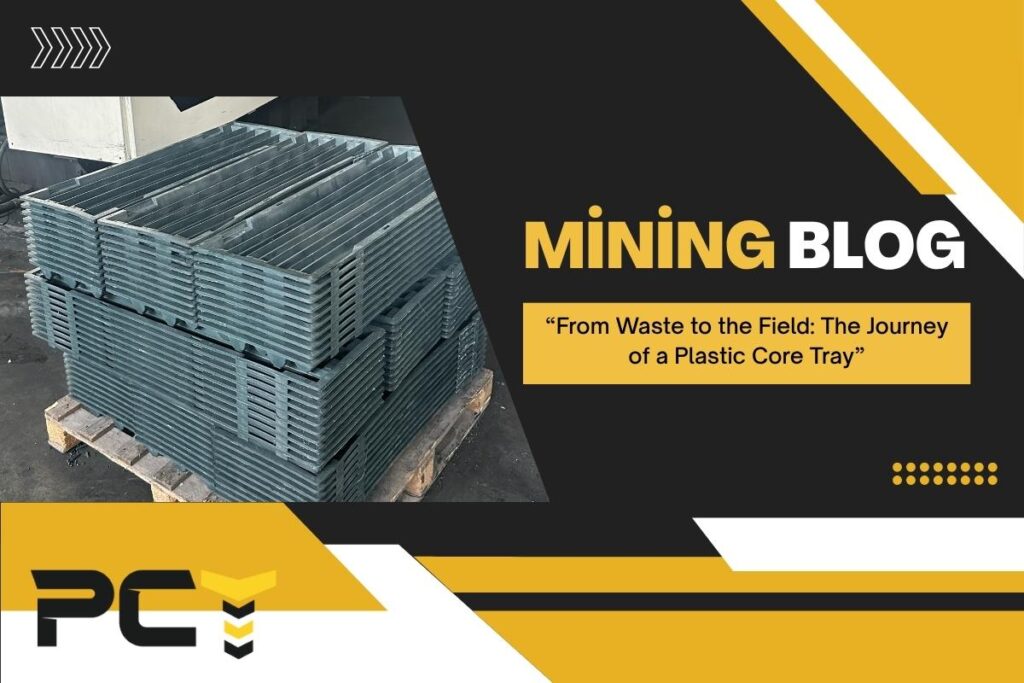
Plastic Waste, Reinvented
In a world where industries are rethinking waste, Plastic Core Trays (PCT) has redefined what sustainability in mining looks like. Once discarded plastic waste now becomes one of the most essential tools in exploration—the plastic core tray. Each year, over 8,900 tons of plastic are diverted from landfills and re-engineered into high-quality trays used by geologists across five continents. What was once single-use waste now supports long-term geological documentation, creating a direct link between recycling innovation and responsible resource development. This isn’t just recycling—it’s a circular economy in motion. Instead of taking new materials from the earth, PCT gives existing resources a second life, aligning industrial needs with environmental stewardship.
The idea is simple:
“If mining reveals the planet’s hidden value, we must ensure our methods protect it.”
From Waste to Worth: Inside the PCT Production Cycle
The transformation from discarded plastic to a durable core tray is a multi-stage engineering process rooted in precision and material science. Each step ensures quality, strength, and environmental responsibility.
1. Collection – Gathering Recyclable Feedstock
The journey begins with collecting used plastics from certified recycling partners. These materials often include high-density polyethylene (HDPE) and polypropylene (PP) — known for their strength, stability, and recyclability. By sourcing waste from industrial and post-consumer streams, PCT ensures a consistent feedstock without relying on virgin petroleum-based polymers.
2. Sorting – Polymer Separation and Quality Control
At the recycling facility, all incoming plastics are sorted by polymer type, density, and colour. This step ensures chemical purity, as mixing incompatible polymers can weaken the final product. Advanced infrared sorting systems and density-based separation tanks help guarantee that each batch has uniform material properties — a crucial factor for injection moulding precision.
3. Cleaning and Decontamination
The sorted plastics are shredded into flakes and thoroughly washed using environmentally safe detergents. Oils, labels, and dust are removed, and the cleaned material is dried under controlled heat. This phase ensures that no contaminants or organic residues affect the integrity of the recycled plastic core trays, leading to consistent mechanical strength and long-term durability.
4. Pelletizing – Creating High-Quality Feed Pellets
The clean flakes are melted and extruded through a pelletizer, forming uniform polymer pellets. These pellets serve as the raw material for manufacturing. At this point, PCT performs melt flow index (MFI) testing to ensure every batch meets the viscosity and tensile requirements necessary for field-grade core trays.
5. Injection Moulding – Engineering the Final Product
Using state-of-the-art injection moulding machines, the pellets are transformed into the familiar, stackable plastic core trays. During this process, the molten plastic is injected into a precision-engineered mould under controlled temperature and pressure. Each tray cools within seconds, taking its final form with exacting dimensional accuracy.
PCT’s trays are designed to:
-
Resist UV radiation, preventing brittleness under sunlight.
-
Withstand impact and chemical exposure, ensuring performance in rugged field conditions.
-
Maintain tight dimensional tolerances, guaranteeing seamless stacking and transport.
6. Quality Inspection and Traceability
Every batch undergoes a rigorous inspection process. Dimensional checks, load tests, and visual inspections confirm that the trays meet both ISO quality standards and field performance expectations. Each production run is traceable — from polymer batch to final shipment — ensuring reliability and accountability in the supply chain.
7. Global Delivery
After inspection, the trays are packaged and shipped to clients worldwide. Thanks to an extensive logistics network, Plastic Core Trays supplies operations in Africa, South America, Asia, and Europe — ensuring that sustainability is delivered on a global scale.
From Factory to Field: A Global Supply Chain
Once produced, every plastic core tray begins a second journey — from the PCT factory to the mining field.
Land Transport:
The trays travel from PCT’s facility to regional warehouses using fuel-efficient, low-emission vehicles.
Sea Freight:
For large mining projects, trays are shipped by container, carefully stacked to reduce wasted volume and transport-related emissions.
Air Freight:
When rapid response is required, lightweight trays can be air-shipped to exploration camps across continents — ensuring projects stay on schedule. Wherever geological drilling takes place, PCT trays arrive field-ready, designed to preserve the integrity of core samples through all climates and terrains.
Powered by Solar Energy
PCT’s sustainability model extends beyond materials—it’s embedded in the factory itself. The facility operates on a 7.3 MW solar energy system, generating enough clean power to offset thousands of tonnes of CO₂ emissions annually — equal to powering over 2,500 homes. Solar-assisted manufacturing not only reduces the company’s dependence on fossil fuels but also ensures cost stability, a crucial factor for long-term supply contracts in the mining industry. Through renewable energy integration, Plastic Core Trays achieves a lower carbon footprint per unit than nearly any comparable industrial manufacturer in its sector.
Material Innovation Meets Field Performance
Sustainability means little if the product cannot perform. That’s why recycled plastic core trays are engineered to match — and in many cases, exceed — the strength and weather resistance of virgin polymer trays.
Each tray’s design balances load-bearing strength, flexibility, and UV stability, enabling use across extreme environments:
-
Tropical zones: Resistant to humidity and microbial growth.
-
Arid deserts: Maintains dimensional stability under high temperatures.
-
Arctic and alpine climates: Withstands freeze-thaw cycles without cracking.
Furthermore, the interlocking stacking system ensures stability during transport, while built-in drainage and labelling channels streamline geological sample management. This combination of mechanical performance and sustainable design makes PCT trays not only environmentally responsible but operationally superior.
Closing the Loop: The Circular Manufacturing Model
At the end of their life cycle, PCT trays can be fully recycled and reintroduced into the production stream. This “closed-loop” process means that the same material may serve multiple lifetimes — first as packaging, then as a core tray, and later as a new tray again. This approach directly supports the United Nations Sustainable Development Goals (SDG 12 & 13), promoting responsible consumption and production while combating climate change through industrial innovation.
Trusted Worldwide
For more than 17 years, PCT has partnered with global exploration companies and drilling contractors. Its trays have become a standard component of sustainable operations worldwide. With a production capacity exceeding 10 million trays annually and a monthly output of over 320,000 units, the company can support projects ranging from pilot drilling to full-scale mining development. Whether it’s lithium exploration in Chile, gold drilling in Ghana, or geothermal sampling in Iceland — PCT plastic core trays are part of the infrastructure that drives the next generation of responsible resource development.
Our Mission: Turning Waste Into Field-Ready Solutions
At Plastic Core Trays, sustainability isn’t an afterthought—it’s the foundation of every product.
The mission is simple yet powerful:
“To transform waste into durable, reliable, and sustainable tools for the mining industry.”
By combining recycled materials, solar-powered production, and global logistics, PCT demonstrates that sustainability and industrial efficiency are not opposing goals — they are partners in progress.
Each tray represents:
-
Reduced landfill dependency
-
Lower emissions and energy use
-
Support for ESG and green-mining commitments
-
A long-term shift toward circular design
Explore the Plastic Core Tray Range
-
SQ Plastic Core Tray – Ideal for SQ-sized samples; engineered for efficient stacking and safe transport.
-
PQ Plastic Core Tray – Designed for large-diameter cores; maximises durability and sample stability.
-
HQ Plastic Core Tray – The balance of strength and capacity; preferred in global exploration campaigns.
-
NQ Plastic Core Tray – Field-tested for standard core sizes; lightweight and easy to handle.
-
BQ Plastic Core Tray – Compact and robust; ideal for small-scale or preliminary exploration programs.
Each tray is part of a shared mission — to make mining more efficient, more reliable, and more sustainable.